STAFYLOS UGV
Anthropogenic climate change and escalating global temperatures present severe threats to global viticulture, with regions across the Mediterranean and Southern Europe experiencing heightened vulnerability. Altered microclimates
have accelerated the proliferation of phytopathogenic fungi which severely compromise fruit quality, diminish crop yields, and threaten total agricultural output. Concurrently, manual field operations conducted during peak
summer temperatures expose agricultural labor to hazardous conditions, increasing the incidence of heat-related illnesses.
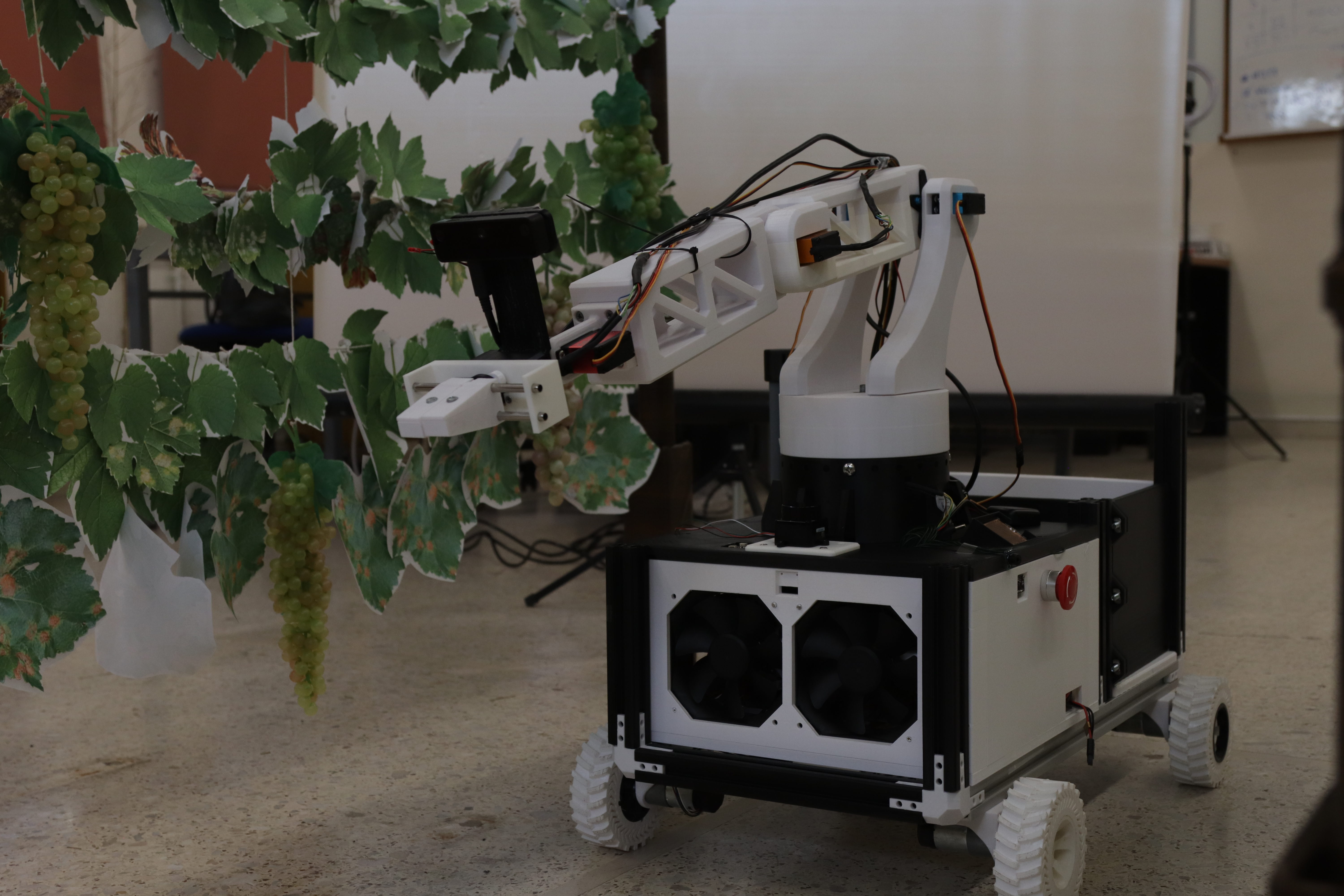
To address these compounding environmental and operational challenges, this work introduces Stafylos: an autonomous Unmanned
Ground Vehicle (UGV) engineered for precision viticulture. By uniting edge-based computer vision with advanced robotic manipulation,
Stafylos performs real-time pathogen diagnostic monitoring and automated crop harvesting. The platform aims to mitigate economic loss
through early disease intervention, streamline yield collection, and safeguard human workers by delegating labor-intensive tasks in extreme
conditions to an autonomous system.
Technical Architecture & Methodology
To achieve autonomous monitoring and physical interaction, the Stafylos UGV integrates high-resolution optical sensors with a custom robotic manipulator.
Real-time visual data captured by the vision architecture is processed locally via an on-board machine learning inference pipeline, enabling edge-based automated
detection of crop diseases directly on vine foliage and fruit clusters. Simultaneously, the robotic manipulator facilitates precise harvesting operations, selectively
picking grape clusters while minimizing mechanical damage to the crops and relieving human labor from extreme ambient conditions.
The system's software architecture and control stack are built upon ROS 2 (Robot Operating System 2), guaranteeing low-latency inter-process communication,
deterministic control, and operational modularity. Telemetry and field diagnostics are transmitted via modern communication protocols, utilizing MQTT for high-throughput
lightweight messaging and LoRa for low-power, long-range connectivity in broad field environments.
Finally, the end-to-end framework is integrated with a fully functional user application, providing agricultural producers with real-time crop analytics, system telemetry,
and remote monitoring capabilities.